
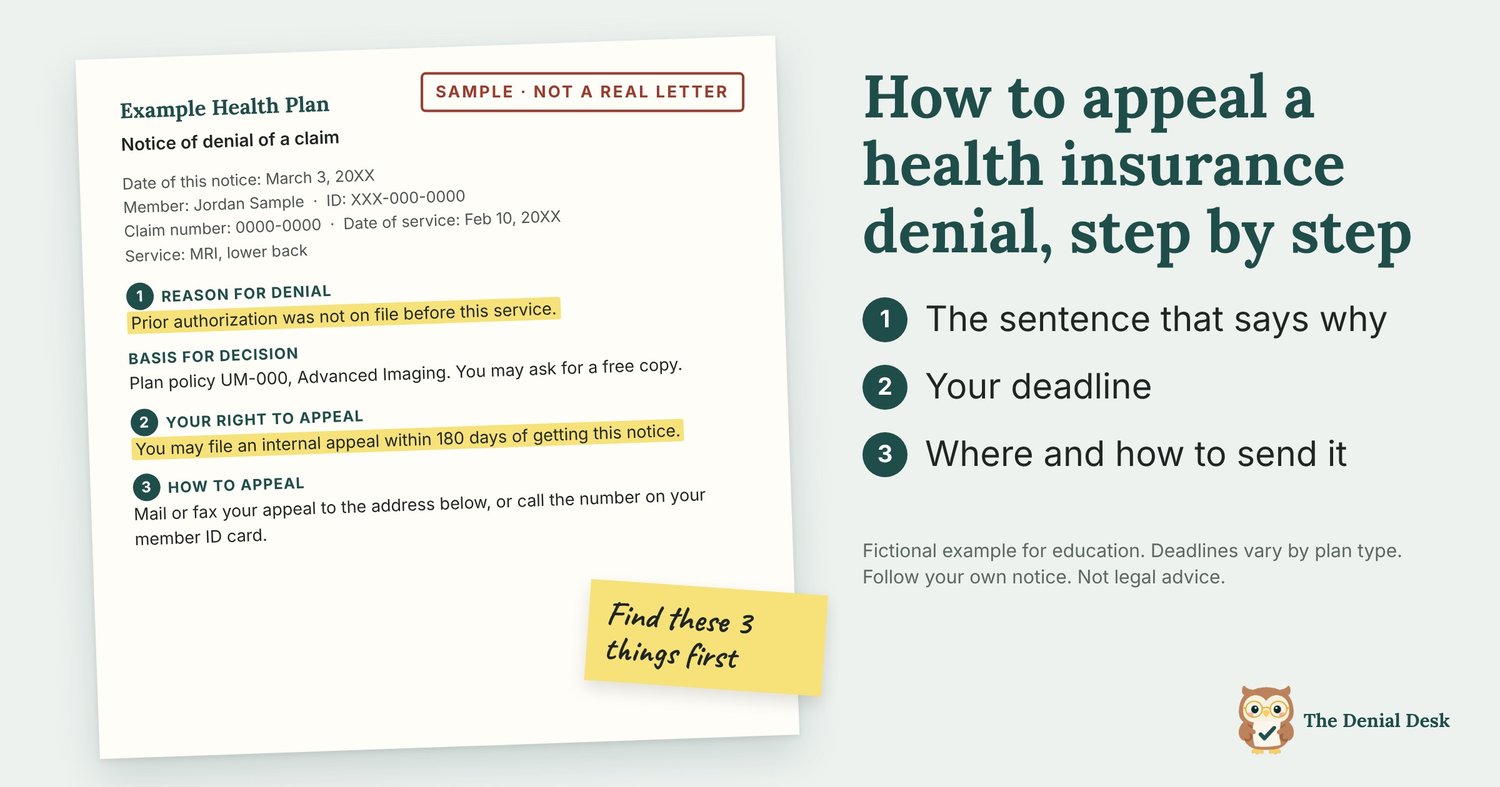
Got a denial letter from your health insurance? You can appeal it, and here is how to do it step by step, with the deadlines that matter.
Most people never appeal. In HealthCare.gov plans in 2024, insurers denied 19% of in-network claims, and fewer than 1% of those denials were appealed. (KFF) Some people don't know they can appeal. Others are sick, worn out, or out of time. These steps are meant to make it shorter.
Who these steps are for: job-based plans and plans you buy yourself, like HealthCare.gov or state marketplace plans. Medicare, Medicare Advantage and Medicaid have their own appeal steps and deadlines. If you have one of those, follow the deadline on your notice, and see Who will help me for free? for the right place to call. A few older "grandfathered" plans may follow different rules too.
Step 1: Read the letter for three things
Find the reason for the denial, the claim or service it is about, and your appeal deadline. The reason is the part you will answer. If the letter is vague, call the number on it and ask them to tell you the exact reason and the policy rule they used. Write down the date, the name of the person, and what they said.
If the letter is confusing, our free Denial Letter Decoder walks through each part of a typical denial letter on one page.
Step 2: Know your deadline
Job-based and Marketplace plans generally give you 180 days from the day you get the denial notice to file an internal appeal. Your notice gives your exact deadline. (HealthCare.gov)
Once you file, the insurer has to decide within 30 days if you haven't had the care yet, or 60 days if you already had it. Urgent cases have to be decided much faster, generally within 72 hours. (HealthCare.gov, Department of Labor)
Step 3: Gather your proof
Ask your doctor's office for a letter that explains why you need the care. Pull your records that back it up: test results, notes about treatments you already tried, and anything the denial letter says is missing. Keep copies of everything you send.
Step 4: Write a short, clear appeal letter
Put your name, member ID, claim number, and the date of service at the top. Say what you are appealing. Answer the denial reason directly, then list what you are attaching. A one-page letter that answers the reason beats three pages of frustration.
Step 5: Send it so you can prove it
Send it the way your letter tells you to: mail, fax, or the online portal. Get proof it arrived, like a fax confirmation or certified mail receipt. Mark your calendar for when the answer is due.
Step 6: If they say no again, ask for an external review
If the insurer keeps the denial after your internal appeal, you can usually ask for an external review by an independent reviewer. You typically have four months from the final denial to ask, and the insurer has to follow the reviewer's decision. (Triage Cancer) If your care is urgent, you can ask for the external review at the same time as your internal appeal. (HealthCare.gov)
Do appeals work?
Some do. In those same 2024 HealthCare.gov plans, insurers upheld 66% of the denials that were appealed (KFF), so about a third were not upheld.
Want the letters done for you?
The Insurance Denial Appeal Kit has 10 appeal letter templates, a step-by-step guide, and a deadline tracker. Fill in the yellow parts, attach your proof, and send.
MRI denied? Read this next: MRI Denied by Insurance? What to Do Next
This is general educational information, not legal or medical advice. Rules and deadlines vary by plan and state, so always follow the instructions on your own letters and notices. The Denial Desk is not affiliated with any insurer, hospital, or government agency.
AI disclosure: This post was drafted with help from AI tools, then reviewed and fact-checked by a certified medical coding professional.